Viking Range Repair
Viking Ignition Faults in Lexington: Spark, Gas or Something Wet
A Viking burner that will not light and one that burns orange, lazy or lifting are often the same fault: the mixture of air and gas at the port is wrong. Work through cap seating, port obstruction and the electrode before assuming an ignition component has failed.
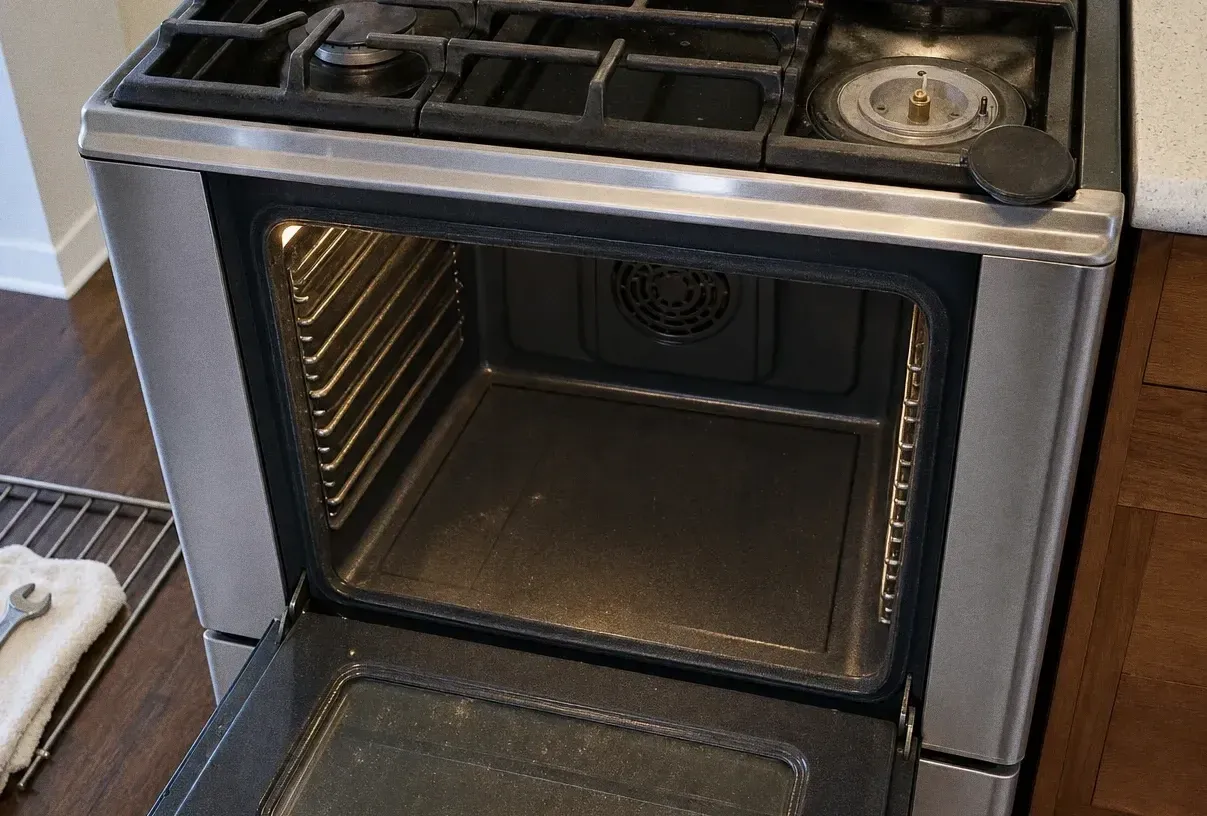
One condition overrides everything that follows. A smell of gas in the room that will not clear means everyone leaves the house first, and the gas utility gets rung from outside it. No part of this guide applies until the air is clear, and a repair firm is not the right first call.
Assuming the kitchen smells of nothing in particular, here is the useful framing. Households usually describe four separate complaints — a burner that will not catch, a flame that burns orange, a flame that is lazy and low, and a flame that lifts away from the ports — and treat them as four separate problems. They frequently are not. All four are downstream of the same variable: the proportion of air to gas where combustion is supposed to happen. That is why the checks below help with the burner that fails to light and with the burner that lights badly.
Start by finding out how much of the range is affected
Establish scope before parts. If exactly one burner misbehaves, the fault is almost certainly in that burner’s own hardware — its cap, its ports, its electrode. If the whole top is affected, attention shifts to the shared module, the gas arriving at the appliance, or the earth the spark relies on. And a range that ticks away with every knob at off is a separate fault again, which has nothing to do with lighting anything.
Hearing the tick means the sparker is alive. Whether gas has reached the port is a completely different question that the sound cannot answer. It is worth being firm about this, because the noise convinces people the ignition side is healthy and sends them looking in the wrong half of the appliance.
Because one generator commonly serves the whole cooking surface, every electrode fires together when you turn a single knob. That is designed behaviour rather than a fault, and it means you cannot identify a failing electrode by sound alone — only by watching.
Make notes as you go: which positions fail, whether they eventually catch, whether the flame looks right once it does, and what changed recently. In the Peacock Farm houses, where the kitchen opens directly onto the living space in a compact mid-century plan, a ticking burner is impossible to ignore and households tend to notice the exact evening it began. That date is genuinely useful.
The mechanical checks, which are most of the answer
The majority of these faults are corrected without tools. A burner cap that is not fully home, ports carrying baked-on spillage, and moisture sitting across the electrode account for most of what gets reported as an ignition failure, and each of them also degrades the flame on a burner that does light.
Cap seating is first because it is the most consequential. When the cap is even slightly proud, gas leaves the burner along a different path than intended, and the mixture where the spark is waiting is no longer the mixture the design assumed. The same misplacement produces a soft, orange, sluggish flame on a burner that manages to catch — which is exactly the connection this guide is about.
Confirm seating by touch rather than by eye. Take the cap from a burner that behaves, lift and re-seat it, and pay attention to how it settles and whether it rocks under a fingertip. Then do the identical thing on the burner in question. A cap that has been dropped, or one that has been swapped between positions during cleaning, often will not sit right on a ring it was not made for.
Ports come next. Cold burner, soft brush, wooden point, patience. Blocked ports change the flame shape locally and can leave the region nearest the electrode dead, which is the geometry that produces a burner sparking into nothing. Do not clear ports with anything that removes metal — a drill bit or a needle enlarges the opening permanently and alters the burner’s behaviour for good.
Finally, moisture. Water left across the electrode after cleaning offers the discharge an easier route than the air gap and suppresses ignition until it has properly dried, which takes longer than the visible surface implies and cannot be usefully hurried. Give it time rather than heat, and try again later.
Reading the spark you can see
Turn the lights down and look at the arc directly. What you want is a tight bright snap, in the same spot each time, crossing from the tip of the electrode to the closest earthed edge of the burner. Consistency is the tell: a spark that appears in different places, or looks weak and stringy, is not doing the job even if it sounds identical to a good one.
The classic defect is a hairline crack in the ceramic sleeve around the electrode. High voltage always takes the easiest path, and a crack offers one straight down to the burner base. The module fires, the click sounds correct, and no energy ever reaches the gas.
Deposits do the same thing without any cracking. A dried film of sugar or fat bridging the gap conducts, and the discharge slides along it instead of arcing through the mixture. That version is often cleanable; the cracked ceramic is not.
The conclusion is worth stating plainly: a spark in the wrong place still makes the right noise. Judge the spark by where it lands, never by how it sounds.
When the electrical side is the answer
The module is a compact high-voltage generator, triggered by a switch that closes behind whichever knob you turn and stops when that switch opens again. That is the whole arrangement — one generator, one switch per knob, a set of leads out to the electrodes.
When a switch fails to open, nothing tells the module to stand down, and the range clicks endlessly with everything in the off position. Liquid finding its way behind the control panel does this temporarily; a switch that has degraded does it permanently. The distinction is time — the damp version fades over hours, the failed switch does not.
This is where the reader should hand over. The fault is behind the fascia among live parts, and getting to it means taking the front of the range apart. In the Lexington Center houses, where the kitchen sits at the back of a deep floor plan and the range came in through a rear door, moving the appliance for access is itself a two-person job worth leaving to the visit.
What is worth a call
Once more, the exception to everything: a gas smell that does not clear means leaving the house and calling the utility. That is not a repair booking, it is a safety call, and it comes before any diagnosis.
Beyond that, three patterns justify a visit. Ignition that arrives after a pause and lands with an audible thump, because gas is collecting before it lights. Clicking that never stops. And a burner that establishes a flame and then loses it moments later, which usually implicates the flame-sensing side rather than the spark.
A technician settles what a kitchen cannot: whether the electrode sits at the correct gap and position, whether the earth path is sound, whether each valve is delivering properly across its range, and whether the burner components on the appliance are the ones that belong on it. Our Viking Range Repair page describes the scope. The $95 service call is where a visit begins; where the work comes down to an igniter or a burner assembly, it runs $280 to $630.
Viking Repair Lexington covers East Lexington, Peacock Farm and Countryside. Have the model number ready, along with a note of which burners are affected, then ring (617) 300-0906 or take the booking link on this page.
Still asked
The flame is orange rather than blue — is that related?
Very often it is the same underlying issue seen from a different angle. Both a burner that will not catch and one burning orange come back to the mixture of air and gas at the ports, so a cap sitting out of position or partly obstructed openings can cause either. Occasional orange flickers caused by household dust are harmless. A steadily orange, soft flame across a whole burner is worth working through properly.
The burner clicks — does that mean the igniter is fine?
Unfortunately not. The sound only confirms that the spark generator is producing output; it says nothing about where that output goes. A cracked ceramic sleeve routes the discharge to the burner base, so the range clicks exactly as it always did while no spark reaches the gas. Turn the kitchen lights down and watch the arc — position and consistency tell you far more than the noise.
All the burners click at once when I turn one knob. What is that?
That is standard on most ranges. One module drives every electrode, so a single knob starts the whole set ticking and it continues until the burner you selected lights. The behaviour to be concerned about is different: ticking that goes on with all knobs at off, or ticking that persists after the flame has settled. Both suggest that a switch behind a knob is no longer releasing the module.