Viking Oven Repair
Viking Oven Still Locked Hours Later in Lexington — Latch, Fuse or Sensor?
The door stays locked until the control reads the cavity below its threshold, which is long after the heat stops — so waiting is usually the answer. A dark display or a breaker that keeps tripping is a power fault instead, and it is why cycle timing matters.
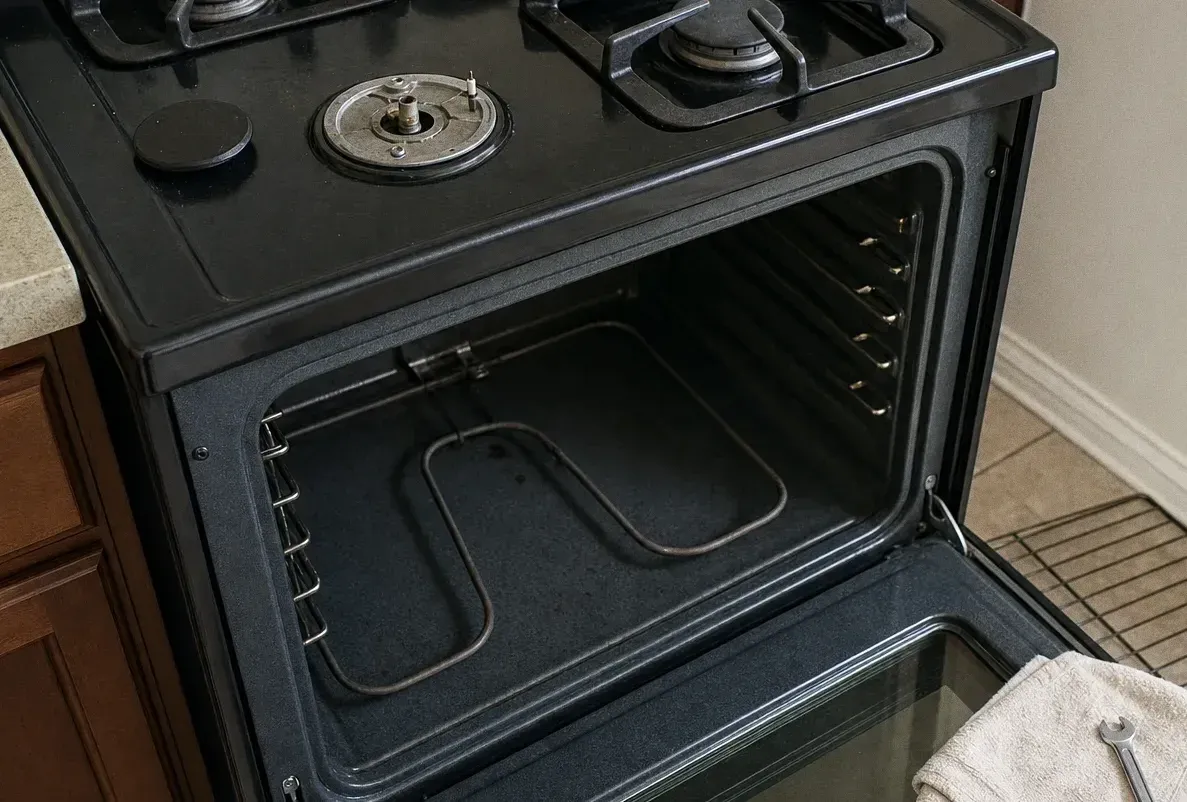
Almost every call about a Viking door that will not unlock arrives in the same week as something important. The cycle was run to get the cavity presentable before company came, and now the appliance has quietly taken itself out of service with the guest list already confirmed.
That timing is not bad luck. A clean cycle is the most demanding hour an oven ever has, and it tends to be scheduled for the days when the household can least afford to lose it. Two things follow from that. The first is a diagnosis, which is what most of this article is. The second is a decision about when to run the cycle in the first place, which may matter more.
Start with the diagnosis, because a locked door immediately after a clean cycle is usually not yet a fault.
The cool-down is part of the cycle
The lock is temperature-driven, not clock-driven. The control keeps the door shut until it reads the cavity as having dropped below a threshold, and because the cycle takes the cavity so far above cooking heat, that reading arrives well after the heating has stopped. The appliance can be cool to a hand held near the glass and still be nowhere near the number the control wants.
The right thing to do while it descends is to observe. Note whether the panel is lit and what it shows, whether the cooling fan is still turning, and whether a code has appeared. A code that comes and goes on its own is still worth recording, and memory of it is worthless an hour later.
The waiting stops being reasonable when the cavity has been at room temperature for hours, the display is behaving normally, and the door is still held. At that point the control is either working from a temperature reading that is wrong or it has issued the release and the hardware has not carried it out — and those are the two branches everything else follows.
A blank display changes the diagnosis
If the panel shows nothing at all, stop thinking about the latch. A dead display means the appliance has lost power or has cut its own, and the shut door is a symptom rather than the fault. This is a different repair with different urgency.
Look at the breaker. In a Lexington Center house where the kitchen sits at the back of a deep floor plan, the panel is usually a walk away in a cellar, and the label on the breaker may date from two renovations ago. One deliberate power cycle is a fair test — off, a pause, back on — and the result tells you something either way.
If it comes back dead with the breaker holding, a thermal fuse is a likely explanation. That component’s whole purpose is to interrupt power when temperature exceeds what the design allows, and the clean cycle is the one operation hot enough to bring it into play. It does not reset. It is a one-shot device that opens for good and is replaced, and its having opened means it did its job rather than failed at it.
What matters here is what you do next. If a breaker trips again after being reset, leave it off and make the call. Cycling it repeatedly to see whether it holds this time puts current back into a circuit that keeps declining it, and the collateral from that habit is worse than the original fault.
Motor, switch, and a control that wants agreement
The lock itself is a small motorised bolt plus a switch that reports its position. An instruction goes out from the control; then the control waits for word that the instruction was obeyed. Nothing opens until those two agree.
Two failures come out of that arrangement, and you can often hear the difference. If nothing moves and no motor runs when the appliance should be releasing, the bolt never went anywhere. If the motor is audible and the door still holds, the more likely story is that the bolt moved and the switch never confirmed it — the control is keeping the door shut on a report it did not receive rather than on a decision to hold.
Heat complicates both. The travel the bolt runs in can stiffen after an extremely hot hour, and anything that spattered and then carbonised can foul it. Neither is diagnosable from the kitchen side, and the assembly sits inside a high-current appliance that has recently been hotter than it has ever been in normal use. This is where a homeowner should hand over; our Viking Oven Repair page covers what the visit involves.
Timing the cycle so a failure is survivable
Here is the honest position. The clean cycle is a legitimate feature that does what it claims. It is also the appliance’s hardest workout, and anything already marginal — a tired element, an ageing relay, a hardened seal — has a decent chance of expiring during it or shortly afterwards. Running the cycle does not create those weaknesses. It finds them.
So treat scheduling as part of the maintenance. Do not run it in the days before a table full of people. Around Patriots’ Day, when half the town has visitors in the house and the Battle Green is booked solid from dawn, is precisely the wrong week to discover the oven has locked itself. Pick a stretch where a fault would be an annoyance rather than a disaster, and where a technician is not competing with a holiday calendar.
The size of the problem also depends on what else you have. A Countryside kitchen rebuilt around both a range and a separate wall oven has a fallback. A compact Peacock Farm kitchen with one cavity does not — losing it means losing all of it. Households in the second category should be more careful about when they press the button, and should treat manual cleaning with a cavity-safe product as the ordinary option rather than the fallback.
When to stop and call
Three things end the do-it-yourself stage: a smell of hot electrical insulation, a breaker that will not stay in, or a door still locked after the cavity has been cold for hours with the display working normally.
Do not try to force it open. The latch is not designed to be overridden by hand, and what usually gives way is the assembly or the door itself, which turns a contained repair into a much larger one.
A technician replaces inference with measurement: the thermal fuse tested for continuity, the latch motor watched for whether a command reaches it and what it does with one, the sensor’s reading taken, and the panel’s code held against the conditions actually present. We cover East Lexington, Peacock Farm and Countryside, and an appointment can be arranged either by telephone or through the booking link shown above.
Still asked
Should I run self-clean before a holiday?
No. Treat the cycle as scheduled maintenance and put it somewhere the calendar is empty. It is the hardest hour the appliance ever works, and marginal components fail during it — which is tolerable in February and ruinous in the week the town fills with visitors. If your kitchen has only one cavity, be stricter still, because losing it means losing everything.
How long should the door stay locked after a self-clean cycle?
Long enough that most households assume something has broken. Release is governed by the temperature the control reads inside, not by elapsed time, so it comes well after the heat has stopped and after the door feels cool to the hand. Your model's guide gives the window for the series. Concern is justified only once the cavity has been cold for hours and it is still held shut.
Will cutting power at the breaker release the latch?
It will not. The bolt stays exactly where it was, and cutting power removes the control's ability to move it at all. Switching off and back on once is a legitimate test of whether the control recovers, but it is a test and not a cure. A breaker that trips again should be left off — the circuit is telling you something, and repeating the reset only widens the damage.